X-rays of the Whole Body Small Drawing
- What is a computed tomography (CT) browse?
- How does CT work?
- When would I get a CT browse?
- What is a CT contrast agent?
- Are there risks?
- What are examples of NIBIB-funded projects using computed tomography?
What is a computed tomography (CT) scan?
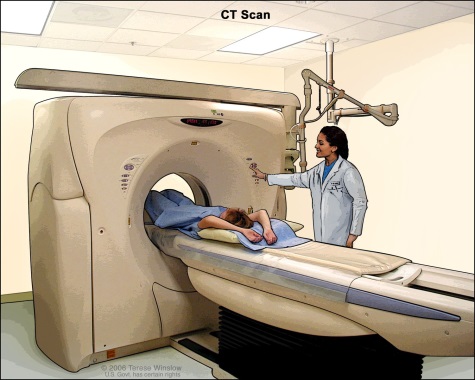
The term "computed tomography", or CT, refers to a computerized ten-ray imaging process in which a narrow beam of x-rays is aimed at a patient and speedily rotated effectually the body, producing signals that are candy by the automobile'southward computer to generate cross-sectional images—or "slices"—of the body. These slices are called tomographic images and comprise more than detailed information than conventional ten-rays. One time a number of successive slices are nerveless past the machine'south computer, they tin be digitally "stacked" together to form a three-dimensional epitome of the patient that allows for easier identification and location of basic structures too as possible tumors or abnormalities.
How does CT work?
Unlike a conventional x-ray—which uses a fixed x-ray tube—a CT scanner uses a motorized x-ray source that rotates around the circular opening of a donut-shaped structure chosen a gantry. During a CT browse, the patient lies on a bed that slowly moves through the gantry while the x-ray tube rotates effectually the patient, shooting narrow beams of ten-rays through the torso. Instead of film, CT scanners use special digital x-ray detectors, which are located directly contrary the x-ray source. As the ten-rays go out the patient, they are picked up by the detectors and transmitted to a estimator.
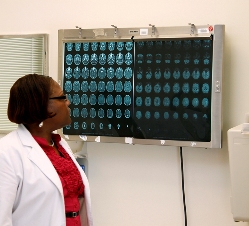
Each time the x-ray source completes 1 full rotation, the CT computer uses sophisticated mathematical techniques to construct a 2nd image slice of the patient. The thickness of the tissue represented in each image slice can vary depending on the CT machine used, but commonly ranges from 1-10 millimeters. When a full slice is completed, the image is stored and the motorized bed is moved forrad incrementally into the gantry. The ten-ray scanning procedure is and so repeated to produce another image piece. This procedure continues until the desired number of slices is nerveless.
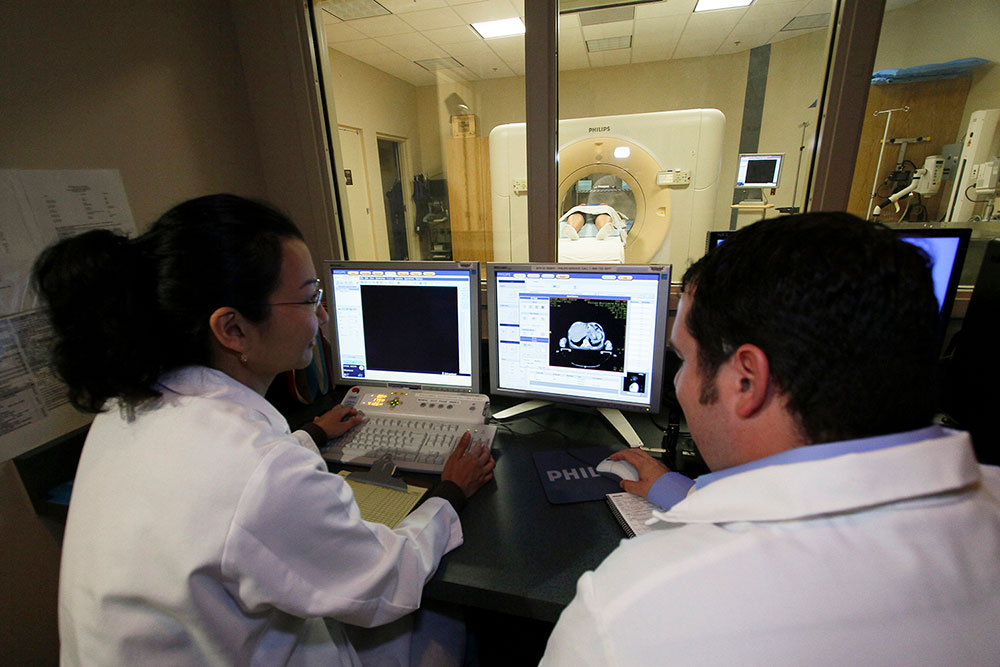
Prototype slices can either be displayed individually or stacked together by the figurer to generate a 3D epitome of the patient that shows the skeleton, organs, and tissues likewise every bit any abnormalities the physician is trying to identify. This method has many advantages including the ability to rotate the 3D image in space or to view slices in succession, making it easier to observe the exact place where a problem may exist located.
When would I become a CT scan?
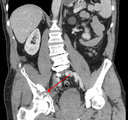
Source: James Heilman, M.D., [CC-BY-SA-three.0]
CT scans can be used to identify illness or injury within diverse regions of the body. For case, CT has become a useful screening tool for detecting possible tumors or lesions within the abdomen. A CT browse of the middle may be ordered when various types of heart affliction or abnormalities are suspected. CT tin also exist used to epitome the head in order to locate injuries, tumors, clots leading to stroke, hemorrhage, and other conditions. Information technology can image the lungs in order to reveal the presence of tumors, pulmonary embolisms (claret clots), excess fluid, and other conditions such as emphysema or pneumonia. A CT scan is specially useful when imaging complex os fractures, severely eroded joints, or os tumors since it usually produces more than detail than would be possible with a conventional x-ray.
What is a CT contrast agent?
As with all x-rays, dense structures within the body—such as bone—are easily imaged, whereas soft tissues vary in their ability to terminate x-rays and, thus, may be faint or difficult to come across. For this reason, intravenous (IV) contrast agents have been developed that are highly visible in an x-ray or CT browse and are rubber to use in patients. Contrast agents contain substances that are amend at stopping x-rays and, thus, are more visible on an x-ray prototype. For example, to examine the circulatory system, a dissimilarity agent based on iodine is injected into the bloodstream to help illuminate blood vessels. This blazon of test is used to expect for possible obstructions in claret vessels, including those in the heart. Oral contrast agents, such as barium-based compounds, are used for imaging the digestive organization, including the esophagus, breadbasket, and GI tract.
Are there risks?
CT scans can diagnose possibly life-threatening conditions such equally hemorrhage, blood clots, or cancer. An early diagnosis of these conditions could potentially exist life-saving. However, CT scans utilise x-rays, and all x-rays produce ionizing radiations. Ionizing radiation has the potential to cause biological furnishings in living tissue. This is a take a chance that increases with the number of exposures added up over the life of an individual. However, the risk of developing cancer from radiations exposure is generally small.
A CT browse in a pregnant woman poses no known risks to the baby if the area of the body being imaged isn't the abdomen or pelvis. In full general, if imaging of the abdomen and pelvis is needed, doctors prefer to use exams that practise not employ radiation, such equally MRI or ultrasound. All the same, if neither of those tin can provide the answers needed, or there is an emergency or other time constraint, CT may be an acceptable alternative imaging selection.
In some patients, contrast agents may cause allergic reactions, or in rare cases, temporary kidney failure. IV contrast agents should not be administered to patients with abnormal kidney office since they may induce a farther reduction of kidney function, which may sometimes get permanent.
Children are more sensitive to ionizing radiations and take a longer life expectancy and, thus, a higher relative risk for developing cancer than adults. Parents may want to ask the technologist or doctor if their automobile settings have been adapted for children.
What are examples of NIBIB-funded projects using computed tomography?
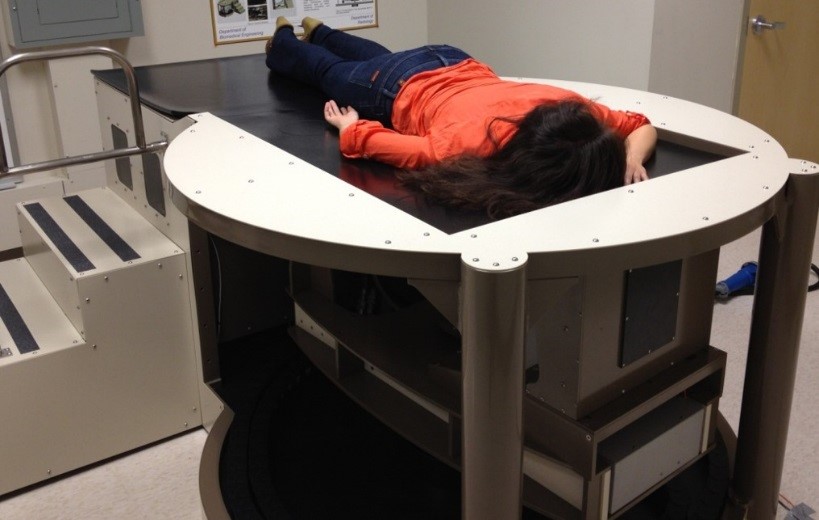
Credit: John Boone, UC Davis
Dedicated Breast CT Scanner: NIBIB is funding research for evolution of a dedicated breast CT scanner that allows the chest to be imaged in 3D and could help radiologists detect hard-to-find tumors. The scanner produces a radiation dose comparable to that of a standard x-ray mammogram and doesn't crave compression of the chest. In this breast CT scanner, a woman lies prone in a specially designed large table with her chest suspended in a special opening in the scanning bed. The scanner rotates around the breast, without passing through the chest, thus reducing the radiation that would be delivered to the breast in a conventional CT scanner. Listen to a podcast about the scanner.
Reduction in Radiation from Routine CT Scans:NIBIB put out a call for researchers to submit groundbreaking ideas that will help to radically decrease the amount of radiation used in CT scans. V new projects are underway from this new funding opportunity, representing creative, innovative, interdisciplinary approaches that would not accept been funded otherwise. Yous can read more than about them below:
Customized imaging
Web Stayman, Johns Hopkins University
The corporeality of radiation required for a CT scan depends on a number of variables, including the size of the patient, the part of the trunk beingness scanned, and the diagnostic task at hand. For case, smaller patients require less radiation than larger patients, and scanning a denser role of the body, such equally soft tissue nearly the pelvis, requires more radiation than scanning the lungs. In improver, diagnostic tasks that crave loftier image clarity, such as locating a faint tumor, generally require more radiations. The goal of this project is to alter both the hardware and software of modern CT systems so that the device can adjust the shape, position, and intensity of the 10-ray axle to the specific imaging scenario. The research leverages patient-specific anatomical models and mathematical models of imaging performance to directly x-rays where they are needed and, consequently, to avoid or to limit x-ray exposure where it is not needed. This will help maximize imaging performance for specific diagnostic tasks while minimizing radiation exposures.
Amalgam tools for researchers
Cynthia McCollough, Mayo Clinic
The goal of this piece of work is to develop resource that enable the research community to easily create and compare new approaches to reducing radiation dose of routine CT scans without compromising diagnostic accuracy. Then far, this has entailed creating a library of raw information from patient CT scans that researchers can dispense to exam new approaches, and developing computer-based methods for evaluating new approaches, so that researchers don't have to rely on radiologists, which can exist costly and time consuming. Using these assets, researchers accept demonstrated that there is considerable potential for radiation dose reduction in CT exams of the abdomen, which are among the highest dose CT exams in mutual clinical use.
Faster processing
Jeffrey Fessler, University of Michigan
To reduce radiation nonetheless still produce good quality CT images, more sophisticated methods are needed to process the raw data from the CT system. Those advanced methods, called image reconstruction algorithms, tin require undesirably long computing times, so they can be used just for some patients currently. The goal of this project is to develop algorithms that are fast plenty to allow low-dose CT imaging to be used for every patient.>
An integrated approach
Norbert Pelc, Stanford Medical Schoolhouse
At every stage in the design of CT scanners, there are opportunities to make changes that reduce radiations dose. Because these changes are inter-related, the goal of this project is to have an integrated approach, exploring approaches such as modifying the photon counting detector (the part of the CT scanner that detects x-rays), dynamic x-ray illumination (adjusting the amount of radiation used throughout the elapsing of a scan), and image reconstruction methods. These will exist tested using a table superlative experimental system. The researchers believe that these combined strategies can lead to as much as lxxx% reduction in radiations dose compared to today's typical systems, and as well enable higher resolution images.
SparseCT
Ricardo Otazo and Daniel Sodickson, New York University School of Medicine
Investigators at New York University School of Medicine, Brigham and Women's Hospital, and Siemens Healthineers are working together to develop a new ultra-low-dose CT technique called SparseCT. The key idea behind SparseCT is to block most of the 10-rays in a CT scan before they reach the patient, but to do so in a way that preserves all the essential prototype data. The approach combines a new x-ray blocking device with the mathematics of compressed sensing, which allows images to be reconstructed from reduced datasets. Compression sensing can exist likened to filming a movie with a very fast, simply low-pixel camera and so using math to catechumen the image to high-definition quality.
Source: https://www.nibib.nih.gov/science-education/science-topics/computed-tomography-ct
0 Response to "X-rays of the Whole Body Small Drawing"
Post a Comment